
Please enter valid Reg. No
Top 10 Common Jaguar XF Engine Problems Every Owner Should Know
- November 19,2025
Top 10 Jaguar XF Common Engine Faults
The Jaguar XF is a luxury saloon with sharp handling and a refined cabin. Its engines range from frugal diesels to powerful supercharged V8, and many owners enjoy years of smooth motoring. However, no car is perfect. Over time, the XF has developed a reputation for certain engine related faults that can be expensive if ignored. Being aware of these problems can help you spot symptoms early, seek help from Jaguar Engine Specialists and protect your investment. Many Jaguar XF owners search for the Jaguar XF engine for sale when they face unexpected failure of their vehicle’s engine. Often, wish they had known the warning signs earlier, so they could have consulted with the specialists and repaired this issue to prevent the whole engine failure. Below you’ll learn about the common faults affecting the 2.0 litre diesel, 2.0 litre petrol, 2.2 litre diesel, 2.7 litre diesel, 3.0 litre diesel and supercharged V8 engines. By getting this information, you will get a clear view of why these issues arise and what you should do in that situation.
Understanding Jaguar XF engines: specs and history
The XF was launched in 2007 to replace the S Type and has gone through two generations. First generation (X250) cars offered a mix of petrol and diesel engines. Petrol options included a naturally aspirated 3.0 litre V6, a 4.2 litre V8 and a powerful 5.0 litre V8; later models added a 2.0 litre turbo four cylinder and a supercharged 3.0 litre V6. Diesel buyers could choose a 2.2 litre four cylinder, a 2.7 litre V6 or a 3.0 litre V6. The high performance XFR used a 5.0 litre supercharged V8 producing 510 PS. The second generation XF (X260) arrived in 2015 with an aluminium structure and Jaguar’s own ‘Ingenium’ engines. This range includes the 2.0 litre turbocharged petrol (P250/P300), the 2.0 litre Ingenium diesel and, on earlier cars, the 3.0 litre supercharged V6 and 5.0 litre V8. Buyers of used XFs should also be aware that the 3.0 litre V6 diesel is generally regarded as the best all round engine, offering strong torque, good fuel economy and reliability.
Common Jaguar XF Engine Problems
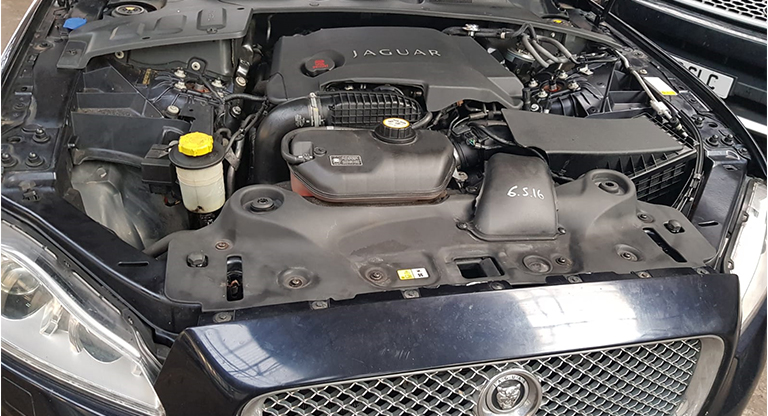
1. Timing chain stretch in the 2.0 litre Ingenium diesel
The 2.0 litre Ingenium diesel introduced in 2015 is known for timing chain problems. Engine oil dilution from incomplete diesel particulate filter (DPF) regeneration leads to inadequate lubrication, causing the chain to stretch. Symptoms include a rattling noise during cold starts and “Restricted Performance” warnings. If ignored, the chain can slip and the pistons collide with the valves, resulting in catastrophic engine failure. Regular servicing with high quality oil and timely chain replacement by a specialist can prevent this expensive problem.
2. Turbocharger failure
Turbo failures are common in the 2.0 litre Ingenium diesel and the older 2.7 litre V6. Carbon deposits and oil contamination can block the turbo oil supply, causing the turbo to seize or the bearings to wear out. Symptoms include loss of power, blue exhaust smoke and a distinctive whining or whistling noise. If replacing the turbo, it is essential to flush the oil lines thoroughly; failing to do so can destroy a new turbo in minutes.
3. Timing belt failure on 2.2 litre and 3.0 litre diesels
Earlier four cylinder 2.2 litre diesel engines use a timing belt rather than a chain. Jaguar specifies replacement at 150,000 miles or 10 years. Exceeding this interval risks the belt snapping, allowing pistons and valves to collide and destroying the engine. The 3.0 litre V6 diesel also has a belt driving the fuel pump that should be changed every 112,000 miles or seven years. Proactive replacement is far cheaper than an engine rebuild.
4. Throttle body and intake manifold failures
On 3.0 litre diesel models, the plastic throttle body and intake manifold can crack or warp. The throttle body failure triggers restricted performance and stops the car from regenerating its DPF. Plastic manifolds can develop leaks around the rocker cover, drawing in unmetered air and causing rough running. Replacement with updated parts cures the problem.
5. Water pump and coolant leaks
Supercharged 3.0 litre V6 and 5.0 litre V8 engines suffer from premature water pump failure. Coolant leaks past the pump’s bearing can lead to overheating. Drivers may see low coolant warnings or puddles under the car. Replacing the pump and using fresh coolant prevents further damage. In all engines, cracked coolant hoses and failed thermostats can also cause overheating.
6. Diesel particulate filter and EGR problems
Diesel XFs use a DPF to trap soot and an exhaust gas recirculation (EGR) valve to reduce emissions. Short trips and infrequent high-speed runs prevent the DPF from regenerating, leading to clogging and a loss of power. EGR valves, especially on the 2.7-litre V6 diesel, clog with carbon and cause rough idling and decreased engine efficiency. Owners should drive the car long enough for the DPF to complete regeneration, and have the EGR valve cleaned or replaced when necessary.
7. Crankshaft failure on V6 diesels
Both the 2.7 litre and 3.0 litre V6 diesel engines have reported crankshaft failures due to spun bearings or cracked crankshafts. The engine suddenly seizes and typically cannot be repaired. Regular oil changes and avoiding extended idling can help, but if you notice knocking noises or low oil pressure, stop driving and have the engine inspected immediately.
8. Ignition coil failure and misfires
Petrol engined XFs can suffer from ignition coil failure, causing misfires, hesitation and rough idling. The Range Rover Engine Specialists note that coil problems often accompany timing chain issues. Replacing faulty coils and spark plugs usually restores smooth running.
9. Engine mount problems
The XF’s engine and transmission mounts are designed to isolate vibrations. Over time, the rubber degrades or cracks, causing excessive vibration at idle or acceleration. You may hear clunking noises as the engine moves or notice misalignment of the engine and transmission. Replacing worn mounts with quality parts restores smoothness and prevents damage to surrounding components.
10. Piston cooling oil jet solenoid failure
The 2.0 litre Ingenium diesel has an electronically controlled piston cooling oil jet solenoid to regulate cooling oil flow. Coolant leaks can corrode the solenoid, causing it to stick and deprive the pistons of cooling oil. This leads to piston damage and excessive engine wear. Addressing coolant leaks promptly and replacing the solenoid reduces the risk.
The Jaguar XF is a sophisticated executive saloon, but its engines have specific weaknesses. By understanding the symptoms and addressing them early, you can avoid costly repairs. Using the correct oil, maintaining the DPF and following the manufacturer’s service schedule will help keep your XF engine healthy for years. If you’re searching for Jaguar XF engines for Sale or already own one, working with experienced Jaguar Engine Specialists ensures the vehicle stays reliable and enjoyable.
Frequently asked questions
How much to replace a Jaguar XF engine?
A replacement Jaguar XF engine costs between £2,500 and £8,000, depending on the engine type and source.
What are the most common Jaguar XF 2.0 diesel engine problems?
The most common Jaguar XF 2.0 diesel engine problems are timing chain stretching, turbocharger failure, DPF clogging, and piston cooling oil jet solenoid failure. These issues often interconnect.
What should I do if my Jaguar engine is producing smoke?
Stop driving immediately and have a specialist diagnose the issue. Continuing to drive causes more damage and increases repair costs.
How long does a Jaguar XF engine last?
With proper maintenance, a Jaguar XF engine can last 150,000 to 200,000 miles or more, depending on the driving habits and engine type.
Are Jaguar XF engines reliable?
Jaguar XF engines have mixed reliability. The 3.0 supercharged V6 and 5.0 V8 are reliable if maintained properly but suffer from expensive timing chain issues. The 2.0 and 2.2 diesel engines have below-average reliability due to timing chain and DPF problems. The 2.7 diesel has the worst reputation for crankshaft failures.
Which Jaguar XF engine is the best?
The 3.0 supercharged V6 offers the best balance of performance and reliability. For economy, the later 2.0 petrol Ingenium engines are reliable and efficient.
What engine oil for Jaguar XF diesel?
Jaguar XF diesel engines require SAE 0W-20 oil meeting Jaguar Land Rover specification STJLR.51.5122. Older models originally specified 5W-20 but Jaguar updated this to 0W-20 for better protection. Always check your handbook for the exact specification.
How do I know the engine code in Jaguar?
Find the engine code on the vehicle identification plate, located in the door jamb or under the bonnet. The code appears as a series of letters and numbers. For example, 2.0 diesel codes include 204DTA and 204DTR. The 3.0 diesel shows as 306DT. You can also use an OBD-II scanner to read the engine code from the ECU.